




The Casualty Blueprint: How the BBC Plans to Rebuild Doctor Who by December
The TARDIS doors may be locked until at least 2028, but behind the scenes, the battle for the future of Doctor Who is reaching a boiling point.

While BBC Studios prepares to battle independent production companies for the show’s lucrative production tender, a separate corporate civil war is quietly brewing over who will actually hold the keys to the script editor’s desk.

Following the seismic news that Russell T Davies and Bad Wolf have officially departed the series, a massive ideological clash has emerged between the former showrunner’s camp and the BBC executive branch regarding who should lead the next era.
The Continuity Candidate: Pete McTighe

Sources suggest that prior to stepping down, Russell T Davies was aggressively championing a familiar face to take over his vacated seat: Pete McTighe.

For Whovians, McTighe is a known and trusted quantity. Having penned Jodie Whittaker-era episodes like Kerblam! and Praxeus, he spent his recent months working intimately as a co-producer and writer for theDoctor Who spin-off, The War Between the Land and the Sea, which aired to critical acclaim on BBC One in December 2025.
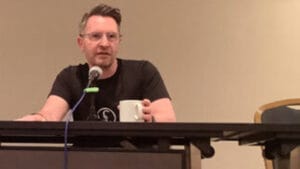
The rumors surrounding his potential promotion grew so loud that the writer was directly cornered by moderators at the Gallifrey One convention. As documented by The Doctor Who Companion and CultBox, McTighe refused to issue a flat denial. Instead, he carefully called it a “party line” situation, adding that while the position wasn’t officially open at the time, “whenever he [Russell] calls, I will come running.”
Choosing McTighe represents stability.
As noted in an analytical breakdown on Bleeding Cool, he understands the grueling, year-round production pipeline of the Whoniverse and holds deep respect for the show’s dense lore. For Davies, McTighe is the safe pair of hands needed to guide the series through its upcoming financial transition.
The Prestige Pivot: Jack Thorne

However, the BBC’s upper management has a vastly different, more radical vision. Reports claim that top executives are holding out hope to lure acclaimed British screenwriter Jack Thorne (His Dark Materials, Enola Holmes) to spearhead the 2028 relaunch.

Thorne is television royalty. Fan communities, including the r/DoctorWhoNews Reddit community, have been actively debating leaked reports that the BBC wants a total structural shift. Rather than traditional “monster-of-the-week” family sci-fi, executives are reportedly angling for Thorne’s signature grounded, social-realist, and high-concept prestige style to pull the show into a darker, more cinematic era.
The goal?
Attract a high-end, BAFTA-courting crowd that could bring in major global co-financiers to replace the lost Disney+ funding.
The “Casualty” Blueprint: Predicting the BBC’s Next Move . . .

While the fandom debates McTighe versus Thorne, the timeline of when we will find out who wins is governed by strict BBC infrastructure. To guess the BBC’s exact next move, we only have to look at how they handled the long-running medical drama Casualty.
When Casualty was put out to a mandatory competitive tender, the process took exactly six months from the initial invitation to the final contract signing. The Doctor Who tender was officially announced on 10 June 2026.

If the BBC mirrors the Casualty framework precisely, the bidding window will lock by mid-autumn, and the BBC will announce the winning production company in December 2026.
Industry production schedules dictate that a massive sci-fi series requires a minimum of 18 to 24 months of active pre-production, set builds, casting, scripting, and filming before a single episode can air. Even if a company wins the contract this December, writing rooms cannot realistically open until early 2027.

Set construction and casting will consume all of 2027, pushing cameras to roll in early 2028. This firmly debunks any fan theories that the show will sneak back onto screens next year, validating the harsh reality that Autumn 2028 is the mathematically earliest premier date.
Lore vs. Prestige: The Ultimate Dilemma . . .

This behind-the-scenes tug-of-war perfectly encapsulates the identity crisis facing modern Doctor Who. As public speculation mounts on platforms like the Radio Times showrunner tracker, the ultimate dilemma remains: do you reward a loyal franchise veteran who understands the fans, or do you hand the keys to a mainstream heavyweight to completely reinvent the wheel?
With the production tender active until the end of the year, a final decision won’t be locked in for months.
But one thing is clear: whoever wins this corporate duel this December will permanently alter the DNA of television’s favorite Time Lord.

 Actors’ Contributions and Ongoing Projects

 Addressing the recent cliffhanger involving