





Doctor Who Tender Bids: Jed Mercurio In Race + Full Timeline Revealed

The corporate battlefield to control the future of Doctor Who is officially heating up.
Following the expiration of the initial submission deadline on 2nd October 2026, the first wave of powerhouse production companies bidding for the highly anticipated 2028/2029 transmission has been revealed.

With the franchise heading into a massive, blank-slate refresh after the high-profile exits of Russell T Davies and Bad Wolf, the BBC is looking for a “relevant, surprising, brave, and inspiring” new vision.
From blockbuster television heavyweights to bold regional shake-ups, these are the contenders officially trying to win the keys to the TARDIS.

The Confirmed Heavy Hitters Bidding for the Tender:
Hat Trick Mercurio (HTM Television)

The Line of Duty Mastermind
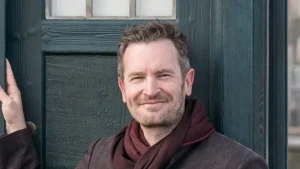
In one of the most explosive revelations of the tender process, industry outlet Deadline confirmed that Jed Mercurio—the acclaimed creator of Line of Duty and Bodyguard—is spearheading a major pitch.
His boutique drama company, Hat Trick Mercurio (HTM), has submitted a formal proposal with Mercurio attached directly as an Executive Producer.
Rather than stepping into the traditional, grueling head-writer showrunner role, Mercurio’s attached executive position would involve overseeing the macro production of this new era.

As Executive Producer, Mercurio would be responsible for shaping the overarching narrative direction of the series, managing the creative team, and ensuring the show perfectly aligns with the BBC’s vision.
Mercurio is a self-professed, lifelong science-fiction fan (having created Invasion: Earth early in his career). His extensive experience in creating massive television phenomena and his deep understanding of the sci-fi genre would serve as highly valuable assets, bringing unmatched narrative tension and institutional trust to the Whoniverse.
World Productions

The Independent Powerhouse
Not to be outdone by their own frequent collaborator, World Productions has submitted its own entirely separate, standalone bid.

Backed by the massive weight of ITV Studios, the 17-time BAFTA-winning production house behind Vigil, Showtrial, and Bodyguard is looking to secure the franchise under its own decorated corporate umbrella.
STV Studios
 Heading North of the Border?
In a move that could radically reshape where the show is filmed, Glasgow-based STV Studios has entered the race.
Partnering with Screen Scotland, STV Studios—the team behind the breakout BBC police drama Blue Lights—is launching a bold bid to move Doctor Who production out of its long-term home in Wales and over the English border into Scotland.

BBC Studios

Bringing the Doctor Back In-House
Determined to keep the commercial rewards of the global brand internal, BBC Studios is fighting hard to win back the franchise.
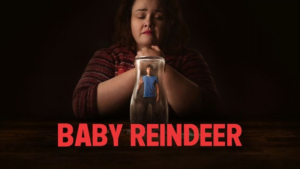
Scripted Managing Director Jamie Hall confirmed that BBC Studios is submitting up to two separate internal bids from its portfolio of owned labels (which includes the creators of Baby Reindeer, Sherwood, and Happy Valley). Their pitch reportedly leans into recapturing the widely popular “core offering” of the iconic David Tennant and Matt Smith eras.
The Hollywood Rumours vs. Reality

While the internet was recently sent into a frenzy by reports that Hollywood powerhouse Dean Devlin and Electric Entertainment were in talks to pitch a David Tennant-anchored return, the actual bidding pool has proven strictly UK-centric.
In fact, the strict rights limitations—where the BBC firmly retains all ultimate IP and distribution rights—have actively scared off many major studios.
 High-profile companies like A24 UK, Mammoth Screen, Playground, and Quay Street have all explicitly chosen not to submit proposals, with some industry insiders calling the tight creative constraints a “thankless task” in the current streaming climate.
Writers and Directors
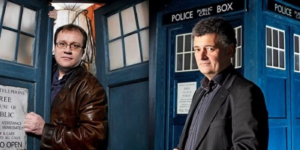
Where is the Creative Shortlist?
For Whovians anxiously waiting to see who will hold the literal pen, there is no official shortlist of individual writers or directors yet.
However we gathered the top 15 contenders. Doctor Who fans and insiders believe could take the helm next. . .
So check out: Who Should Be the Next Doctor Who Showrunner?
Because the invitation to tender is currently navigating its corporate and structural phase, specific creative talent has not been locked down. However, the BBC’s 21-page tender document explicitly reveals that they are not strictly looking for a single showrunner model.
Instead, companies are being actively encouraged to pitch a collaborative writers’ room model utilizing multiple episodic writers. This is exactly where Mercurio’s executive structure fits perfectly.
While he handles the overarching vision and creative management, a dedicated team of episodic writers and directors would be assembled beneath him.
The precise pool of these writers won’t be formalised until further along in the selection process.
 In a @thedailydalek Facbook survey:
📊 THE BIG DEBATE we asked . . .
Do you prefer a single Showrunner with a unified vision (like RTD or Moffat), or is it time for Doctor Who to adopt an American-style Writers’ Room for more collaborative storytelling?
Daily Dalek fans overwhelmingly voted for the: Showrunner.
While fans are currently facing an extended live-action hiatus—comforted only by the upcoming preschool animated series TARDIS Crew on CBeebies—the BBC is moving efficiently behind the scenes.

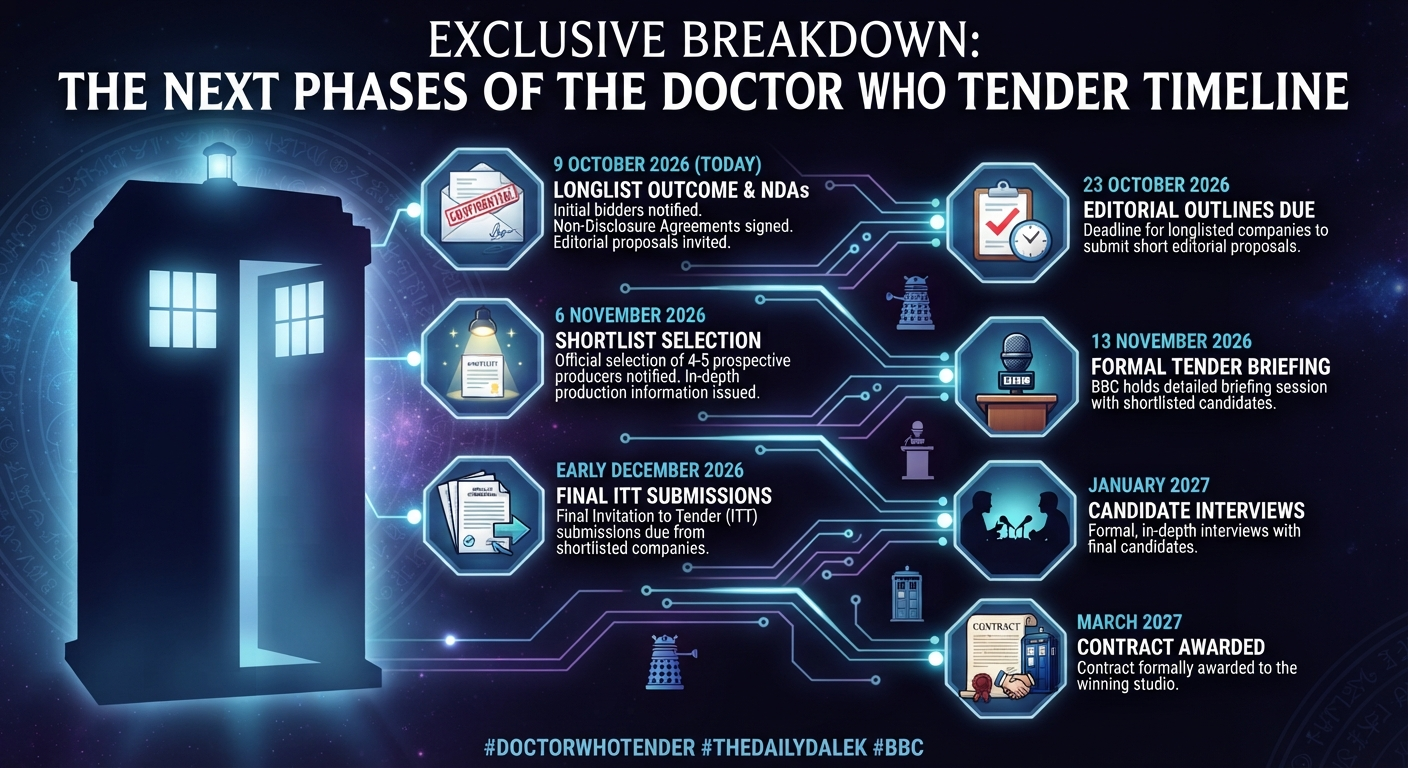
The corporate submissions are now navigating a strict, multi-stage vetting process. The detailed step-by-step roadmap for the future of the franchise is laid out below:
- 9 October 2026 (Today): Longlist Outcome & NDAs
The BBC is officially notifying the initial bidders of the “longlist” outcome. Longlisted companies are required to sign non-disclosure agreements (NDAs) and are formally invited to submit a brief editorial proposal. - 23 October 2026: Editorial Outlines Due
The deadline closes for the longlisted companies to submit their short editorial outlines. - 6 November 2026: Shortlist Selection
The official shortlist of four to five prospective producers is selected and notified. These final companies will be issued secondary, in-depth production information and invited to a formal tender briefing. - 13 November 2026: Formal Tender Briefing
The BBC holds its formal tender briefing session with the shortlisted candidates. - Early December 2026: Final ITT Submissions
Final Invitation to Tender (ITT) submissions are due from the shortlisted companies. - January 2027: Candidate Interviews
Formal, in-depth interviews with the final candidates take place. - March 2027: Contract Awarded
The contract is formally awarded to the winning studio.
- 9 October 2026 (Today): Longlist Outcome & NDAs
The final contract will mandate a multi-episodic series including holiday specials. To satisfy Ofcom regional criteria, the successful bidder must establish a clear regional production base outside of London, with the BBC maintaining a strong institutional preference for Wales.
Stay tuned to The Daily Dalek as we continue to track every step of this historic corporate regeneration!

 The online community has been buzzing ever since the Brazilian fan handle Puxadinho da Tardis (
















 The Abandoned Festive Special: “Winternox” and Easter Daleks
 Fixing the Billie Piper Cliffhanger: “A Piece of Piss”

 What’s Next for the Whoniverse?