How Hollywood Could Win the BBC Tender to Produce Doctor Who . . .
The TARDIS doors may be locked until the absolute earliest of 2028, but behind the scenes the corporate battlefield is fully active.
With Russell T Davies and Bad Wolf officially departing the series, and BBC Studios boss Zai Bennett confirming that the BBC is entirely committed to a long-term future for Doctor Who, all eyes are on the upcoming competitive tender process.
Naturally, the rumor mill is spinning out of control. We’ve all seen the bombshell reports originally published in The Times and analyzed by CultBox claiming that Hollywood powerhouse Dean Devlin (Independence Day, Stargate) and his studio, Electric Entertainment, are already “in talks” with the BBC.
Even more shocking are the whispers that David Tennant is the prime target to anchor the pitch, with rumours that he has already been approached to gauge his interest in returning to the role yet again.
Predictably, the fandom has erupted. Half the timeline is screaming in excitement over a potential blockbuster budget, while the other half is pointing out that a premature negotiation like this would be a massive, unethical violation of the BBC Charter.
So, what is actually going on . . .
Can Devlin really pitch a David Tennant relaunch right now, or are these reports running directly into a legal brick wall?
Why This Isn’t Like the 2021 Bad Wolf Deal
To understand why these rumors are raising eyebrows, we have to look back at how Bad Wolf took the wheel in 2021. Many fans assume Devlin is just trying to replicate that exact transition.
But the rules have fundamentally changed . . .
In 2021, Doctor Who bypassed a public, competitive bidding war entirely through a direct co-production agreement.
Because the show was legally owned and produced by BBC Studios—the BBC’s commercial, for-profit arm—they were legally allowed to form a private, commercial partnership with Bad Wolf behind closed doors. BBC Studios simply outsourced the day-to-day physical production.
Fast forward to today: the massive Disney+ co-funding era has ended, and the BBC has officially triggered a formal “intent to tender” for Season 16.
This means the show must be offered as a work-for-hire contract to the entire independent production market simultaneously.
Under public procurement law, the closed-door handovers of the past are dead. In fact, BBC Studios has to enter the bidding war as a regular competitor just like everyone else.
The Tennant Factor . . .
Nostalgia vs. Fatigue
The inclusion of David Tennant’s name in the report acted like a lightning rod across Doctor Who forums and social media.
On one hand . . . (pun intended), Tennant is the undisputed golden boy of the modern era; his brief return for the 60th Anniversary specials brought a massive ratings spike and reminded the world of his effortless chemistry with the role.
For a contingent of fans, especially those worried about the show’s current global footprint, the idea of an American-backed, high-budget “Tennant Era 4.0” feels like a guaranteed way to steady a rocking ship.
Yes, we say 4 . . .
True Whovians know that if Devlin gets his way, this wouldn’t just be Tennant’s third era—it would technically be his fourth time taking the reigns.
If you count his original 2005 debut, his infamous in-universe stunt of channeling regeneration energy into his own severed hand in Journey’s End, and his 2023 return as the Fourteenth Doctor, Tennant has made an absolute art form out of hogging the TARDIS wardrobe.
But on the other hand (pun absolutely intended), a massive wave of fan fatigue has hit the community.
Many viewers feel that leaning on Tennant yet again would be a creative admission of defeat, signaling that the franchise is entirely incapable of moving forward without its favorite safety blanket.
Fandom consensus online quickly highlighted that Doctor Who’s core superpower is regeneration and reinvention. Constantly hitting the “Break Glass in Case of Emergency” button on the Fourteenth Doctor risks undermining Ncuti Gatwa’s legacy and shrinking a vast, infinite universe into a repetitive loop of mid-2000s nostalgia.
The Myth of the Private Pitch
This brings us back to the Dean Devlin and David Tennant rumors.
Let’s squash the biggest misconception: No independent production company can privately pitch creative concepts, scripts, or casting choices to the BBC right now.
Because Doctor Who is heavily funded by the British public and governed by a strict BBC Charter, the moment a competitive tender is announced, it triggers massive anti-collusion and anti-bias frameworks.
The BBC is legally obligated to maintain an absolute level playing field. If a BBC executive sat down for a private coffee with Devlin to look at a treatment or discuss bringing Tennant back to boost ratings, it would grant Electric Entertainment an unfair information advantage.
The consequences?
The entire tender process could be voided, and the BBC would face multi-million-pound lawsuits from rival bidders.
Unsurprisingly, when pressed on the matter by Radio Times, Devlin himself directly clarified the situation on 11 August 2026: “It is untrue that we have had negotiations with the BBC. Preliminary or otherwise. When the proper time comes when they are prepared to speak with people, we certainly hope to have a discussion with them.”
The Right to Pre-Assemble a Bid (The Studio-to-Talent Loophole)
But we need to be precise about what the rumor actually claims. We do not know if the BBC has been formally pitched anything yet. Instead, the speculation centers on Devlin—who famously directed David Tennant in the 2018 thriller Bad Samaritan . . . leveraging his personal Hollywood connections to build a massive bid.
Is a move like this an explicit breach of the BBC Charter, or are we simply witnessing a masterclass in exploiting legal grey areas?
When you strip away the frantic forum threads, there are legal mechanisms that explain how this sort of David Tennant groundwork can happen right now without breaking a single procurement law.
While the BBC is legally locked down and cannot have private creative discussions with production companies, outside studios face no such restrictions.
Under standard UK bidding frameworks, a company like Electric Entertainment is fully entitled to pre-assemble its entire “dream team” in private. In fact, to submit a winning bid later this year, they must prove to the BBC that they have the creative infrastructure and star power ready to go.
Because David Tennant has a strong working relationship with Devlin, Devlin would simply be playing smart corporate chess. Securing a tentative “yes” from a global star like David Tennant is a classic Hollywood tactic; it allows a studio to attach a massive commercial asset to their application framework long before they ever submit it to the BBC eSourcing Portal.
Preliminary Market Engagement . . . What Is Allowed?
The second half of the controversy involves the reported general chats surrounding the BBC. Critics argue that any dialogue prior to the ITT grants an unfair advantage. However, public procurement law explicitly leaves the door open for a process called Preliminary Market Engagement (PME).
Before the BBC can publish a massive tender for a flagship brand like Doctor Who, they are legally required to test the waters of the global television industry.
They cannot design a contract in a vacuum; they have to hold general, high-level discussions with major production hubs to ensure their technical and financial expectations are realistic.
During these early market chats, the rules are rigid:
The BBC’s Boundary: Executive staff are strictly forbidden from discussing creative ideas, scripts, or specific casting choices. They cannot say, “We want David Tennant back,” or hint at a specific creative direction.
The Studio’s Strategy: A studio like Electric Entertainment can use these general market feedback sessions to signal their scale, their financial health, and their readiness to handle a top-tier sci-fi property.
The Budget:Dean Devlin’s independent studio, Electric Entertainment, typically targets lean and efficient production budgets around $15 million to $30 million per project, bypassing major Hollywood studio overheads by keeping VFX and financing in-house. To scale production flexibility, Devlin secured a $100 million credit facility with Bank of America to independently fund his film and TV slates.
As long as the BBC keeps meticulous records of these chats and eventually shares the core technical insights with all registered bidders, the boundary remains intact.
The Waiting Game for Season 16
The official, legal window for real dialogue only opens once the Invitation to Tender (ITT) is formally published on the BBC eSourcing Portal.
When that document drops, the process becomes entirely automated. Companies will download the exact creative and technical criteria the BBC is looking for, and submit their formal bids. If Devlin wants to pitch a David Tennant return, he will have to write it into a formal application document and submit it along with everyone else, completely anonymously.
So, if you hear rumors that a specific studio has already charmed the BBC executive branch with a radical new vision for the Daleks or a dream casting choice, take it with a massive grain of salt . . .
The battle for the keys to the TARDIS is a rigid legal marathon, and the real sprinting hasn’t even begun.
The TARDIS doors may be locked until at least 2028, but behind the scenes, the battle for the future of Doctor Who is reaching a boiling point.
While BBC Studios prepares to battle independent production companies for the show’s lucrative production tender, a separate corporate civil war is quietly brewing over who will actually hold the keys to the script editor’s desk.
Following the seismic news that Russell T Davies and Bad Wolf have officially departed the series, a massive ideological clash has emerged between the former showrunner’s camp and the BBC executive branch regarding who should lead the next era.
The Continuity Candidate: Pete McTighe
Sources suggest that prior to stepping down, Russell T Davies was aggressively championing a familiar face to take over his vacated seat: Pete McTighe.
For Whovians, McTighe is a known and trusted quantity. Having penned Jodie Whittaker-era episodes like Kerblam! and Praxeus, he spent his recent months working intimately as a co-producer and writer for theDoctor Who spin-off, The War Between the Land and the Sea, which aired to critical acclaim on BBC One in December 2025.
The rumors surrounding his potential promotion grew so loud that the writer was directly cornered by moderators at the Gallifrey One convention. As documented by The Doctor Who Companion and CultBox, McTighe refused to issue a flat denial. Instead, he carefully called it a “party line” situation, adding that while the position wasn’t officially open at the time, “whenever he [Russell] calls, I will come running.”
Choosing McTighe represents stability.
As noted in an analytical breakdown on Bleeding Cool, he understands the grueling, year-round production pipeline of the Whoniverse and holds deep respect for the show’s dense lore. For Davies, McTighe is the safe pair of hands needed to guide the series through its upcoming financial transition.
The Prestige Pivot: Jack Thorne
However, the BBC’s upper management has a vastly different, more radical vision. Reports claim that top executives are holding out hope to lure acclaimed British screenwriter Jack Thorne (His Dark Materials, Enola Holmes) to spearhead the 2028 relaunch.
Thorne is television royalty. Fan communities, including the r/DoctorWhoNews Reddit community, have been actively debating leaked reports that the BBC wants a total structural shift. Rather than traditional “monster-of-the-week” family sci-fi, executives are reportedly angling for Thorne’s signature grounded, social-realist, and high-concept prestige style to pull the show into a darker, more cinematic era.
The goal?
Attract a high-end, BAFTA-courting crowd that could bring in major global co-financiers to replace the lost Disney+ funding.
The “Casualty” Blueprint: Predicting the BBC’s Next Move . . .
While the fandom debates McTighe versus Thorne, the timeline of when we will find out who wins is governed by strict BBC infrastructure. To guess the BBC’s exact next move, we only have to look at how they handled the long-running medical drama Casualty.
When Casualty was put out to a mandatory competitive tender, the process took exactly six months from the initial invitation to the final contract signing. The Doctor Who tender was officially announced on 10 June 2026.
If the BBC mirrors the Casualty framework precisely, the bidding window will lock by mid-autumn, and the BBC will announce the winning production company in December 2026.
Industry production schedules dictate that a massive sci-fi series requires a minimum of 18 to 24 months of active pre-production, set builds, casting, scripting, and filming before a single episode can air. Even if a company wins the contract this December, writing rooms cannot realistically open until early 2027.
Set construction and casting will consume all of 2027, pushing cameras to roll in early 2028. This firmly debunks any fan theories that the show will sneak back onto screens next year, validating the harsh reality that Autumn 2028 is the mathematically earliest premier date.
Lore vs. Prestige: The Ultimate Dilemma . . .
This behind-the-scenes tug-of-war perfectly encapsulates the identity crisis facing modern Doctor Who. As public speculation mounts on platforms like the Radio Times showrunner tracker, the ultimate dilemma remains: do you reward a loyal franchise veteran who understands the fans, or do you hand the keys to a mainstream heavyweight to completely reinvent the wheel?
With the production tender active until the end of the year, a final decision won’t be locked in for months.
But one thing is clear: whoever wins this corporate duel this December will permanently alter the DNA of television’s favorite Time Lord.
The Real Reason Global Doctor Who Fans Are Stranded Until 2027
For the past few years, global Doctor Who fans have enjoyed a golden era of television parity . . .
Thanks to a high-profile international distribution deal, fans in New York, Sydney, and London could watch Ncuti Gatwa’s adventures simultaneously. That era of unity came to a crashing halt with the release of the five-part Doctor Who spin-off, The War Between the Land and the Sea.
Barclay Pierre-Dupont, played by Russell Tovey, a low-level civilian clerk for UNIT.
While UK fans watched the Homo Aqua crisis unfold on BBC One back in December 2025, international audiences have been left stranded in a devastating broadcast desert. Following months of silence, lead star Russell Tovey recently confirmed a shocking update to Radio Times: global viewers will not get the series on Disney+ until 2027.
Frankly, something smells fishy about this entire timeline.
How did international audiences end up with a year-plus delay for a completed show in the age of instant streaming?
Salt is a Homo Amphibia and serves as the Ambassador of the Homo Aqua species played by Gugu Mbatha-Raw
@thedailydalek dives into the deep (pun intended) corporate waters, contract mechanics, and behind-the-scenes politics causing this massive gap.
1. The Corporate Breakup . . . The End of the Disney Deal
The most significant factor behind this fishy delay is the quiet death of the BBC and Disney+ Branded Television partnership. As industry reports confirm, Disney officially exited its co-production agreement with the BBC after a brief two-year run.
According to details shared with UK media outlets, the contract covered a strict 26-episode limit. This spanned the 60th-anniversary specials, Series 14 and 15, and the five episodes of The War Between the Land and the Sea.
Because Disney chose to walk away from funding the main show’s future, the Sea Devils spin-off ceased to be a marketing priority for the platform and was quietly pushed down their scheduling pipeline as they prepared to exit the Whoniverse entirely.
2. A Shift in “Simultaneous Release” Strategy
During the height of the partnership, simultaneous global drops were mandated to build global hype. However, The War Between the Land and the Sea was explicitly negotiated with different regional windows.
The BBC retained the rights to make it a marquee winter event for UK license fee payers, launching it on 7 December 2025 on BBC iPlayer and BBC One. Initial press briefs suggested an “early 2026” streaming window for international fans.
However, as industry coverage tracking the platform’s schedules revealed, Disney skipped major release windows throughout the first half of this year. This created a severe “holdback window” where the UK broadcast took commercial precedence.
COMING SOON . . .
3. When in 2027 can international audiences expect to see it?
While Russell Tovey admitted to Radio Times that he doesn’t know the exact day or month yet, industry patterns point directly to January 2027.
Because the show wrapped its UK run at the end of December 2025, it is highly likely bound by a standard 366-day terrestrial broadcast holdback contract. Once that calendar year expires in late December 2026, Disney is legally cleared to release the episodes globally. With the BBC-Disney relationship already at an end, expect Disney to drop the episodes early in the year to fulfill and close out their contractual books.
The Fan Backlash . . . “It’s Like the 1990s all over again”
The delay has caused immense frustration, particularly in the US and Australia, where fans have had to dodge internet spoilers for months. Speaking exclusively to Radio Times, Russell Tovey didn’t hold back, comparing the gap to the pre-internet era. . .
“It feels like we’ve gone back to the ’90s with this. I remember in the ’90s, you’d go to Blockbuster and there’d be a film out in America and you’d have to wait like six months until it came out in the UK… Like, we’ve got it here, and they have to wait.” [Radio Times]
If you refuse to wait until 2027 to watch Kate Lethbridge-Stewart face off against the Sea Devils, you don’t have to. International fans have the option of buying the physical DVD or Blu-ray directly from UK outlets.
The Region Code Trap: UK Blu-rays are traditionally encoded for Region B. They will not play on standard North American (Region A) Blu-ray players or standard home gaming consoles.
The Solution: To watch the UK disc, you will need a Region-Free (Multi-Region) Blu-ray player. Alternatively, standard DVDs are frequently Region 0 (All Region), but you will sacrifice high-definition quality.
Where to Buy: Verified UK retailers that ship globally include Amazon UK and specialist media exporters like Rarewaves.
Who Will the BBC Partner with Next?
With the House of Mouse officially exiting the Whoniverse after 2027, BBC Studios is already looking for its next big financial backer. Producing high-end sci-fi on a BBC budget alone is unsustainable, making a new co-production partner inevitable. Who is at the top of the wishlist?
Sony Pictures Television: This is the most logical choice. Sony bought a majority stake in Bad Wolf (the production company behind Doctor Who) back in 2021. Because Sony already controls the physical production pipeline of the show, expanding their role to global distribution would streamline the entire operation.
Netflix: The streaming giant is always hungry for established, reliable IP with a built-in global fanbase. While Netflix likes to own its content completely, a pure distribution deal similar to their past arrangements with Black Mirror or Better Call Saul outside the UK could work perfectly.
Amazon Prime Video: Amazon has proven they are willing to spend massive amounts of money on established sci-fi and fantasy brands (such as The Lord of the Rings and Fallout).
If they want a reliable, family-friendly anchor for their streaming service, outbidding competitors for Doctor Who would be a major coup.
Doctor Who is facing the biggest financial hurdle in its 60-year history, with former showrunner Chris Chibnall warning that the BBC can no longer afford to fund the TARDIS’s adventures alone.
For months, the Whovian corner of the internet has been locked in fierce debate. From Reddit threads to YouTube video essays, fans have blamed the show’s current off-air status on everything from divisive script writing to casting changes.
But according to former Doctor Who showrunner Chris Chibnall, the fandom is looking in entirely the wrong direction. The real culprit behind the empty 2026 release schedule isn’t a creative failure—it’s a massive cash crisis.
Chris Chibnall talks The Parkwood Murders…and Doctor Who Tendor 43:50 / 1:40:16
Speaking on the WHO Corner to Corner podcast, Chibnall broke his silence on the current state of the franchise, delivering a stark reality check for fans.
“The BBC can’t afford to fully fund any drama now, and it certainly can’t afford to fund Doctor Who,” Chibnall explained.
He urged fans to stop fighting over plot points and look at the harsh economic reality facing British television. According to Chibnall, 15 years of restrictive flat-rate funding agreements, combined with the meteoric rise of “big Hollywood monoliths and conglomerates,” have effectively priced the BBC out of making high-concept science fiction independently.
“This is primarily about money,” Chibnall stressed. “It’s not really about all of the things that everybody is banging on about and moaning about. The BBC wants to make Doctor Who. Don’t be in any doubt about that. This is a BBC that cannot afford to make shows that it wants to make.”
How Did We Get Here? A Timeline of the Current Crisis
To understand why the TARDIS doors are locked, we have to look at the perfect storm of departures and financial shifts that hit Whoniverse production:
May 2025 – The Doctor Departs: Ncuti Gatwa’s vibrant era as the Fifteenth Doctor officially concluded, leaving the iconic role vacant.
Mid-2025 – The Disney+ Exit: Following a shifting streaming market, Disney pulled out of its international co-production and distribution deal after just two seasons. This instantly stripped the show of its massive Hollywood-level budget.
June 2026 – RTD Steps Down & Christmas Cancelled: Returning executive producer Russell T Davies officially announced his departure from the series. Concurrently, the BBC confirmed that the planned 2026 Christmas Special was scrapped, putting the show into an indefinite broadcast hiatus.
The “ITT” Production Tender: What’s the Hold-Up?
In response to the budget deficit, the BBC took a drastic corporate step. On 10 June 2026, the broadcaster announced an Invitation to Tender (ITT) for Doctor Who.
For non-industry folks, this means the BBC is actively looking to hand over the physical manufacturing and production rights of the show to a third-party external company. Previous production powerhouse Bad Wolf is out of the picture for the next era, leaving the rights up for grabs.
However, Chibnall pointed out a major catch that explains why we haven’t heard any update on a new production team. Industry outlets like IGN and Bleeding Cool report that the tender process is currently bottlenecked. Because Disney left such a massive financial void, external production companies cannot realistically bid on making the show until the BBC secures a new, primary global streaming partner to help foot the bill.
Whovian Rumours vs. Financial Reality
What the Fandom Is Saying 💬 . . .
The BBC has permanently cancelled the show because of low ratings.
What Is Actually Happening 💰 . . .
The BBC is deeply committed to the brand but is forced into a tactical pause to secure private capital.
What the Fandom Is Saying 💬 . . .
The Disney split happened because of creative differences over the narrative.
What Is Actually Happening 💰 . . .
Disney restructured its global streaming budget, cutting back on costly external co-productions.
What the Fandom Is Saying 💬 . . .
A new Doctor and Showrunner will be announced any day now.
What Is Actually Happening 💰 . . .
Pre-production is completely stalled until the legal and budgetary framework of the “ITT” tender is solved.
What Lies Ahead for the Whoniverse?
While a long hiatus is incredibly tough for a fandom that just celebrated a massive 60th anniversary milestone, it is important to remember that Doctor Who is not dead. It has survived a 16-year cancellation before, and it will survive this financial hurdle.
Reassuringly, Zai Bennett (CEO and Chief Creative Officer of BBC Studios Global Content) has firmly stated that the show has a definitive future. The BBC’s goal is to rebuild a viable, long-term co-production structure from the ground up so the series can eventually return “in all its glory.”
It will take patience, a new global streaming partner, and a brand-new creative team to get the TARDIS spinning again—but the universe still needs the Doctor, and the BBC is doing the background work to make sure they return.
Jon Culshaw Returns as the Twelfth Doctor in Exciting New Audio Adventure
Fans of Doctor Who have a thrilling new reason to celebrate as Jon Culshaw reprises his role as the Twelfth Doctor in the latest Big Finish audio series, The Twelfth Doctor Adventures: Run Fast, Be Kind. This fresh set of stories fits neatly into the Twelfth Doctor’s timeline, taking place between the Christmas specials The Husbands of River Song and The Return of Doctor Mysterio.
Set after the Doctor’s final adventure with River Song, the series explores the Doctor’s life as a widower. Joining him on this journey is a brand-new companion, Ash Wilton, a travelling bard from the edge of the universe, brought to life by actor Gwithian Evans.
The series is being released as six weekly episodes, with the third installment, The Beautiful and the Damned, delving into the darker side of social media. Inspired by the toxicity and addictive nature of digital platforms, the story offers a sharp commentary on online behaviour and the pressures of maintaining a perfect image.
Jon Culshaw describes the story as “a beautiful commentary” on the digital world’s challenges, while writer Katherine White reveals she drew inspiration from her own social media experiences.
Culshaw debuted as the Twelfth Doctor in the special release Merlin’s Trap, followed by subsequent audio ranges like Wings of Steel.
Culshaw studied Peter Capaldi’s vocal cadence, pace shifts, and emotional range to transition from a broad comedic impression to a sustained dramatic performance, he also previously voiced other iconic Doctor Who legacy figures for Big Finish, including the Brigadier and the Master.
Originally portrayed on screen by Peter Capaldi, who does not work with Big Finish because he prefers to leave his era as the Twelfth Doctor untouched. He has stated that he feels returning to the role would cheapen the emotional weight and finality of his departure from the television series.
Capaldi believes his character’s arc ended perfectly with his final speech and regeneration, and he wants to leave that artistic statement alone. He has expressed a general lack of interest in multi-Doctor specials, cameos, or audio spin-offs.
The Twelfth Doctor Adventures: Run Fast, Be Kind is available now as downloadable episodes, continuing the legacy of one of Doctor Who’s most beloved incarnations.
Hollywood producer and lifelong Whovian Dean Devlin has officially launched an ambitious campaign to take over Doctor Who—but can an American independent studio actually secure the keys to the TARDIS?
Following the BBC’s bombshell announcement that Doctor Who will be put out to a competitive production tender after the current era wraps up, Devlin has entered the race.
The Independence Day and Stargate co-writer used a panel at San Diego Comic-Con (SDCC) and active social media campaigns to ask fans if his company, Electric Entertainment, should pitch for the series.
While the prospect of a Hollywood heavy-hitter funding the show is intriguing, Devlin faces a steep, uphill battle across three major fronts: the law, the fanbase, and his own creative track record.
1. The Legal and Regulatory Hurdles
Can an American production company even win a BBC tender . . . Legally, it is incredibly complicated.
The BBC retains full intellectual property rights over Doctor Who.
By law, the corporation must adhere to strict Charter and Agreement requirements regarding “Made outside London” quotas, British cultural identity, and the use of UK creative talent.
Doctor Who has brought millions of pounds into the Welsh creative economy through its Wolf Studios base in Cardiff. If an American company took over, it is highly uncertain whether the BBC would allow production to move out of the UK.
Furthermore, BBC Studios has already confirmed it is bidding to retain the production rights. Boasting 60 years of experience with the brand, BBC Studios executive leadership stated they are entering the tender “with gusto” and are “in it to win it”. An independent, US-based company like Electric Entertainment would struggle to match that institutional leverage without a major UK co-production partner.
2. Fan Reactions and the “AI” Controversy
The announcement has split the Whovian community on social media, sparking intense debate on Reddit, X, and Facebook . . .
The Post: Dean Devlin shared a video asking followers if Electric Entertainment should partner or bid on the potential Doctor Who production tender.
Devlin appeared to use AI tools to generate his promotional video
On one side, optimistic fans note that Devlin’s past work on The Librarians has a fun, escapist “vibe” that could get Doctor Who back to basics.
Aldis Hodge
Commenters on Devlin’s page have playfully embraced the idea, with some suggesting casting his frequent collaborator Aldis Hodge as the next Doctor.
However, Devlin’s social media pitch video has drawn sharp criticism from industry watchdogs. Commentators from Doctor Who Production Newspointed out that Devlin appeared to use AI tools to generate his promotional video.
“My first thought is that he’s not impressing anyone by employing AI to create this video,” the page posted, adding that a company pitching for a major flagship drama should offer a higher standard of creative presentation.
3. Deep Dive: Devlin’s Sci-Fi Track Record
If Devlin does pull off a miracle, what would a Devlin-led Doctor Who look like? His 30-year career provides clear clues.
Alongside Roland Emmerich, Devlin co-wrote and produced the original 1994 Stargate film. His television work via Electric Entertainment includes The Ark, The Outpost, and The Librarians. These shows are famous for high-concept, ensemble-driven storytelling that leans heavily into fun, fast-paced adventure.
The Librarians explicitly featured a TARDIS Easter egg
Devlin’s love for the show is already baked into his filmography. Leverage features numerous characters using aliases inspired by Doctor Who, and an episode of The Librarians explicitly featured a TARDIS Easter egg. Crucially, he has previously hired classic Doctor Who writers like Tom MacRae (The Girl Who Waited) and Gareth Roberts (The Shakespeare Code) to write for his American television series.
2018 thriller film Bad Samaritan
He also knows how to direct a Time Lord. Devlin cast Tenth and Fourteenth Doctor actor David Tennant as the dark, psychopathic villain in his 2018 thriller film Bad Samaritan, proving he has a direct line to the franchise’s most iconic alumni.
RUMOR MILL:
The Times (via Cultbox) reporting Dean Devlin’s Electric Entertainment has had preliminary talks with the BBC, and has even reached out to Tenth (and Fourteenth) Doctor David Tennant to discuss the idea of bringing him back.
The Daily Dalek Verdict
Dean Devlin has the sci-fi pedigree, the passion, and the Hollywood budget to inject something completely fresh into a franchise that the BBC admits is currently facing a period of “regeneration”.
However, until Electric Entertainment can prove it can bypass the strict British legal guidelines of a BBC tender—and win back fans alienated by AI promotional videos—the keys to the TARDIS will likely remain out of Hollywood’s reach.
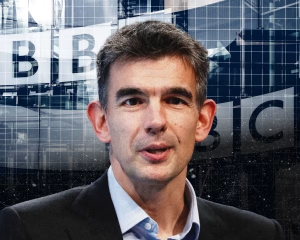
The BBC says it is actively planning the next phase of Doctor Who after recent changes left the show’s future uncertain.
Director‑General Matt Brittin told the corporation’s 2026 annual report that the BBC is “working hard” to regenerate the long‑running sci‑fi series. He confirmed the franchise is being put out to competitive tender, meaning other platforms will be invited to bid to make future episodes.
Brittin pointed out that Doctor Who has undergone many reinventions across its more than six decades and said the BBC is confident it can renew the show creatively. “We can creatively renew content and shows that people love, and we’ll be working hard on that right now,” he said in the report.
The most recent TV run concluded in May 2025 with a surprise regeneration: Ncuti Gatwa’s Doctor transformed into Billie Piper, who had previously appeared in the series as companion Rose. The cancelled Christmas episode was intended to follow on from that finale.
The BBC also confirmed that a Doctor Who animation series for younger audiences is currently in production for CBeebies, signalling parallel efforts to keep the brand active across platforms.
First broadcast in 1963, Doctor Who has become one of British television’s best‑known exports. After an original run that ended in 1989, the programme was successfully revived in 2005. Over the decades, actors including William Hartnell, Tom Baker, Sylvester McCoy, Christopher Eccleston, David Tennant, Matt Smith and Jodie Whittaker have taken on the role of the Doctor.
As the BBC seeks bids and considers creative directions, fans can expect a period of transition — but the corporation insists Doctor Who will return in refreshed form when new arrangements are finalised.


 This brings us back to the Dean Devlin and David Tennant rumors.


 The official, legal window for real dialogue only opens once the Invitation to Tender (ITT) is formally published on the